Shorts, Explained
The calculation basis behind our Shorts and 10-minute lectures: the statute it rests on, the conditions used, and the numbers written out in full. Entries with a published video include it; the rest are text only.
Each entry lays out the full working behind a Short or a lecture: the statute it rests on, the conditions used, and the arithmetic written out. All 154 are available in English. Statute names stay in Korean so you can look them up.
- Same ₩1.3B in homes, comprehensive real estate tax of ₩69,121 vs ₩923,682: the order of the calculationThe tax is paid by whoever owns the home on June 1, on the official assessed price, person by person. Deduct ₩1.2B for a single home (₩900M otherwise), multiply by 60% to get the tax base, apply the rate, subtract the overlapping property tax and add the 20% rural development tax. A one-home owner gets up to 80% off for age and holding period. Figures are for the tax paid in December 2026; the August 3, 2026 government proposal has not passed the National Assembly and is not included.Read the full piece →Read the explainer
 ShortThe dependent deduction is not set by age — the ₩1M income line divides itEach dependent removes ₩1.5M from taxable income, so the tax saved is ₩1.5M × your rate. At ₩50M of total pay, after the ₩12.25M earned income deduction, the 15% bracket applies, so one dependent saves ₩225,000, ₩247,500 with local income tax, and two save ₩495,000; at ₩80M the 24% bracket gives ₩360,000, ₩396,000 each. If a brother on ₩50M and one on ₩80M split two parents, having the ₩80M brother claim both is over ₩290,000 cheaper. A proposal to raise the ₩1M line to ₩3M has not passed as of 2026-09-05.Read the full piece →Read the explainer
- November interim income tax — who gets a bill and who does not₩4M last year means a ₩2M bill; ₩900,000 means ₩450,000 and no bill; ₩1M means ₩500,000 and a bill, so ₩100,000 of last year's tax decides whether a bill arrives. First-half income of ₩10M with ₩3M of deductions gives a ₩17M base, ₩1.29M computed, half ₩645,000, under the 30% line of ₩1.2M, so you may file and keep ₩1,355,000; at ₩20M the estimate is ₩2,145,000 and filing is not allowed. Above ₩10M the excess can be split two months later, and above ₩20M up to half.Read the full piece →Read the explainer
 ShortThe national pension is not set by what you have paid so far — filling months through back-payment and voluntary enrollmentAt ₩3M income joining in 2010, the pension is ₩361,933 at 10 years, ₩528,384 at 15, ₩693,673 at 20, ₩860,124 at 25 and ₩1,026,574 at 30, a little over ₩160,000 per five years. Under 10 years there is no pension, only a lump sum; 10 years pays half the basic amount, rising 5% a year to 20, and 5% a year beyond. Five years of back-payment at ₩3M is ₩285,000 a month, ₩17.1M in total, and the extra ₩160,000 over 20 years is nearly ₩40M in today's money.Read the full piece →Read the explainer
 ShortMoney you get first even at auction — priority payment is set by the table on the mortgage date, not the contract dateThe table revised on 21 February 2023 gives ₩55M for deposits of ₩165M or less in Seoul, ₩48M for ₩145M or less in the overconcentration control area, Sejong, Yongin, Hwaseong and Gimpo, ₩28M for ₩85M or less in metropolitan cities, Ansan, Gwangju, Paju, Icheon and Pyeongtaek, and ₩25M for ₩75M or less elsewhere. The fixed-date priority is the second line ranked by date; priority payment is the first line, needing only move-in and resident registration before the auction filing. At a home value of ₩80M the cap is ₩40M, and in a ₩200M home with three small-deposit tenants ₩100M ÷ 3 gives ₩33.33M each.Read the full piece →Read the explainer
 ShortTax for a landlord collecting rent — separate taxation under ₩20M, combined aboveOn ₩12M a year, unregistered with ₩30M of other income: expenses ₩6M, no deduction, base ₩6M, ₩924,000; with ₩15M of other income the ₩2M deduction gives ₩616,000; registered, expenses ₩7.2M and a ₩4M deduction leave a base of ₩800,000 and ₩123,200. Monthly rent is taxable from one home, and jeonse deposits are taxed as deemed rent from three homes (couple combined) with deposits over ₩300M, so three homes totaling ₩500M give ₩3.72M a year.Read the full piece →Read the explainer
 ShortThe heavy capital gains rate is not set by house count alone — regulated area and sale date decide itA second home under the heavy rate is 60%, ₩299.81M; a third is 70%, ₩354.54M; without the heavy rate the 20% long-term deduction of ₩100M leaves a ₩397.5M base at 40%, ₩146.36M, so one regulated-area designation moves ₩153.45M. The heavy rate suspended from 10 May 2022 for four years resumed on 10 May 2026, and contracts signed by 9 May are excluded if settled by 9 September for existing regulated areas (Gangnam, Seocho, Songpa, Yongsan) or 9 November for new ones. As of 2026-09-05 the 2027 relief proposal has not passed.Read the full piece →Read the explainer
 ShortStock taxes are not set by profit — three cells: domestic, overseas, major shareholderSelling ₩50M of KOSPI shares costs ₩100,000 whether you made ₩20M or lost ₩10M, and ten sales cost ₩1M. Overseas gains net of losses less ₩2.5M are taxed at 22%, an effective 16.5%, and since the broker does not withhold you file yourself the following May. Interest and dividends above ₩20M have the excess combined and can end dependent status. As of 2026-09-05 the wider separate taxation of dividends is a government proposal.Read the full piece →Read the explainer
 ShortUnemployment benefit is not set by salary — cap, floor and benefit daysThe floor is the ₩10,320 minimum wage × 8 hours × 80% = ₩66,048, so 60% of ₩3M, ₩58,696, is lifted to the floor; the cap is a base daily amount of ₩113,500 × 60% = ₩68,100, so ₩4M and ₩8M are the same. Under 50, days run from 120 for under a year to 240 for ten years or more, and 50 or over reaches 270, so ₩3M with one year is 150 days, ₩9,907,200; ten years is 240 days, ₩15,851,520; and 50 or over with ten years is 270 days, ₩17,832,960, nearly ₩8M apart from one year.Read the full piece →Read the explainer
 ShortWeekly rest-day pay is not set by the hourly wage — 15 hours a week is the lineFourteen hours a week is 61 hours and ₩629,520 a month with no rest-day pay; 15 hours adds 3 rest hours for 78 hours, ₩804,960 and an effective ₩12,384 an hour. Twenty hours gives 4 rest hours, ₩41,280 a week; 40 hours gives 8, ₩82,560, and 48 hours still 8. An 'inclusive' ₩10,320 wage splits to a base below the minimum, and claims expire after three years.Read the full piece →Read the explainer
 ShortSocial insurance is not four — five lines of rates, and the ceiling that sets the ratioThe five lines on ₩3M are pension 4.75% ₩142,500, health 3.595% ₩107,850, long-term care at 13.14% of the health premium ₩14,172, employment 0.9% ₩27,000. At ₩6.59M the pension is ₩313,025, and ₩7M and ₩10M are the same, so ₩7M totals ₩660,743, 9.44%. The floor is ₩410,000.Read the full piece →Read the explainer
 ShortCounting gross pay backwards — negotiating a salary for ₩3M take-home₩2.5M take-home needs ₩2,843,000 gross and ₩34,116,000 a year; ₩3M needs ₩3,472,000 and ₩41,664,000; ₩4M needs ₩4,806,000 and ₩57,672,000. The multiple grows from 1.14 at ₩2.5M to 1.2 at ₩4M. The ₩472,000 gap at ₩3M is ₩337,388 of social insurance and ₩134,563 of tax, so premiums are 2.5 times the tax.Read the full piece →Read the explainer
 ShortTake-home pay is not set by the annual salary — how social insurance and the withholding table split the same ₩4MAt ₩4M single, income tax is ₩195,960 and local income tax ₩19,596; with a spouse and one child income tax is ₩88,760 and take-home rises by ₩117,920; with two children take-home is ₩3,560,880, so the family cell moves over ₩160,000. Social insurance is ₩291,522 on ₩3M, 9.72% of pay, and ₩388,696 on ₩4M. The deduction ratio is 12.44% at ₩3M, 17.1% at ₩5M and 20.95% at ₩7M, rising with pay.Read the full piece →Read the explainer
 ShortProperty tax is not set by the market price — three layers: official price, fair market value ratio, tax capAt an official price of ₩500M the tax base is ₩300M; the standard rate gives ₩570,000 and the special rate ₩420,000, plus 20% local education tax, for ₩504,000 on one home and ₩684,000 on a second, an ₩180,000 difference. A one-home ₩900M official price pays ₩1,512,000; ₩1B gets no special rate and pays ₩2,124,000. The assessment date is the owner on 1 June, half is paid in July and half in September, and above ₩2.5M a split is available.Read the full piece →Read the explainer
- Marry or have a child and you can receive ₩100M more — a deduction stacked on the ₩50M₩150M of wedding funds carries no gift tax; ₩300M carries ₩19.4M where it would have been ₩38.8M without the deduction. It applies per recipient, so the groom from his parents and the bride from hers can each receive ₩150M, ₩300M as a couple, but one set of parents giving the whole ₩300M means ₩19.4M. If the engagement breaks, return the money or file an amended return within three months.Read the full piece →Read the explainer
 ShortAcquisition tax on a gifted home is not set by the official price — market value since 2023Under the old method on a ₩400M official price it would have been ₩15.2M, leaving you over ₩7M short at settlement. Inheritance acquisition tax is 2.8% on the official price, ₩11.84M, ₩10.96M less than the gift, but that ignores the ten-year add-back and fixed value. Acquisition tax is due within 60 days of receipt, before the three-month gift tax deadline.Read the full piece →Read the explainer
- Giving versus leaving — how the same ₩500M splits between a gift and an inheritanceIf the assets grow 3% a year, leaving them means over ₩2.7B after 11 years and ₩530.96M of tax, whereas gifting ₩500M now fixes it at ₩500M for a total of ₩340.02M, ₩190.94M less, and even if added back after five years saves ₩30.9M. On an ₩800M estate, gifting ₩300M costs ₩38.8M while leaving it costs ₩0.Read the full piece →Read the explainer
 ShortGift tax is not set by this gift — an earlier gift within ten years raised the rateAfter ten years the earlier gift drops out and the deduction revives, so ₩200M received ten years later is ₩19.4M. If each parent gives ₩100M, it is ₩200M from one person, ₩19.4M, against ₩9.7M if wrongly counted separately as ₩4.85M × 2, a ₩9.7M difference. File within three months of the end of the month of the gift, even when no tax is due.Read the full piece →Read the explainer
 ShortInheritance tax is not paid in one go — ten-year installments and the interest they cost₩87.3M becomes two payments of ₩43.65M under the split, or, because each installment must exceed ₩10M, eight payments over seven years of ₩10,912,500 with ₩9,472,050 in surcharges for a total of ₩96,772,050. ₩300M becomes eleven payments over ten years of ₩27,272,727 with ₩46.5M in surcharges.Read the full piece →Read the explainer
- Inheritance tax is set by deductions, not by the estate — ₩0 up to ₩1B, and more with a surviving spouseWith a spouse and children, the ₩500M lump sum plus the ₩500M spousal minimum means no tax up to ₩1B. On a ₩2B estate where the spouse inherits ₩1B, the spousal deduction is a little over ₩857M and the tax ₩128.87M; with nothing to the spouse it is ₩232.8M. As of 2026-09-05 the estate-tax method applies and the reform proposal has not passed.Read the full piece →Read the explainer
 ShortAcquisition tax is not set by the price — the same ₩600M home pays ₩6.6M or ₩74.4M depending on house count and area₩610M is 1.0667%, ₩6,506,870; ₩750M is 2%, ₩15M; ₩900M is 3%, ₩27M. A ₩600M home as a second home in a regulated area costs ₩50.4M including local education tax and as a third home ₩74.4M, so signing without counting houses costs ₩67.8M more. File and pay within 60 days of acquisition.Read the full piece →Read the explainer
- 90 days of maternity leave pays ₩8.2M, not ₩9M — and who pays it depends on the size of the companyAn employee with ₩3M in monthly ordinary wages receives ₩8.2M over 90 days of maternity leave, not ₩9M. At a small or medium company it is ₩6.6M from employment insurance + ₩1.6M from the employer; at a large company, ₩6M from the employer + ₩2.2M from employment insurance. The missing ₩800,000 comes from the benefit cap (₩6.6M for 90 days ≈ ₩2.2M a month). Four steps: the 90-day clock, whose wallet pays, the cap and the floor, and the father's 20 days with the 2026-09-18 amendment.Read the full piece →Read the explainer
- An EV's ₩130,000 vehicle tax is not a discount — a 2,000cc car the same size pays ₩520,000, and the EV simply has no displacement to measureA 1,998cc passenger car pays about ₩520,000 a year (base tax ₩399,600 + 30% education tax); an EV pays ₩130,000. That is not a discount. The tax's ruler is displacement, and an EV has none, so it lands in the flat ₩100,000 box. Four steps: the per-cc rate table, the vehicle-age reduction formula (50% at year 12), the 'other passenger vehicles' box, and annual prepayment versus installments. Then come the four lines of the tax bill.Read the full piece →Read the explainer
 ShortOne line about the tenant's deposit reshapes the tax — how the same ₩600M apartment became ₩101.85M or ₩67.05MGive a ₩600M apartment to your child outright and the gift tax is ₩101.85M. Have the child take over the ₩300M lease deposit and the tax splits into the child's ₩38.8M gift tax and the parent's ₩28.25M capital gains tax. That is ₩67.05M in total, ₩34.8M less. Four steps: the two laws (Inheritance and Gift Tax Act Art. 47 · Income Tax Act Art. 88), the parts of the calculation, the tax office's proof step (Art. 47(3)), and acquisition tax plus the homes where this backfires.Read the full piece →Read the explainer
- Unpaid wages vanish if you wait and grow if you know — how ₩9M piled up ₩1.73M in a single year₩3M a month unpaid for three months, then you leave: ₩9M. A year later, 20% annual late-payment interest has added ₩1.73M (₩4,932 a day). Four steps: the 14-day clock, interest that now accrues during employment too, the simplified substitute payment (wages ₩7M · severance ₩7M) and the insolvency substitute payment, then the 3-year limitation, criminal penalties and treble damages. After that comes a checklist for the first month of arrears.Read the full piece →Read the explainer
- 8.8% is a rate that exists in no tax law — why ₩88,000 left a ₩1M lecture fee: 20% × a deemed 60% expenseWithholding on a ₩1M outside lecture fee is ₩88,000 (8.8%). The statutory rate is 20%, but the Decree deems 60% of the fee to be expenses. Contest prizes get an 80% deemed expense (4.4%), paintings and antiques worth ₩60M or more per piece 90% (2.2%). Other-income amount of ₩3M (₩7.5M in lecture fees) is the line where you keep a choice, and a lecture that repeats every month crosses into business income at 3.3%. Four steps.Read the full piece →Read the explainer
- The self-employed have a severance account too — how ₩40M of business income gets ₩990K back every year, and creditors cannot touch itA business owner with ₩40M of business income who pays in ₩6M a year gets ₩990K back at a marginal rate of 16.5% (local tax included, assumed). Four steps: how the account works, the income deduction whose cap grows as income falls, Article 119 of the Small and Medium Enterprise Cooperatives Act that blocks seizure, and the exit fee table that splits closure (retirement income) from a change of heart (other income).Read the full piece →Read the explainer
- Same investment, ₩1.54M in tax versus ₩297K — what one account changed, and the 3-year priceTwo people each earned ₩10M in interest and dividends and lost ₩3M on another product. In an ordinary account, 15.4% on the full ₩10M is ₩1.54M; in a low-income ISA, net profit of ₩7M minus a ₩4M allowance leaves ₩3M at 9.9%, ₩297K. A fivefold gap. Four steps: the account's shape, the three devices, the price of 3 years and caps, and the three exits after year three.Read the full piece →Read the explainer
- ShortSame ₩600K rent, one gets a ₩1.22M rent credit and the desk neighbor gets ₩0 — the difference was the claim, not the rulesFor an employee paying ₩600K a month on a ₩50M salary, the credit is ₩7.2M × 17% = ₩1.224M. A colleague paying the same rent gets ₩0 in rent credit. The rules were the same. They never claimed. The colleague still receives the ₩130K standard tax credit, so the real gap is ₩1.094M. Four steps: who qualifies, how much, why people miss it, and how to recover missed years (amended-return claim, 5 years), plus the spouse credit added on 2025-12-23.Read the full piece →Read the explainer
 ShortProtecting a ₩300M jeonse deposit costs ₩880 a day — how an insurance the riskiest homes cannot buy becomes a screening tool before you signThe guarantee fee on a ₩300M apartment deposit is ₩321K a year, ₩642K for two years (₩880 a day); the same ₩300M in a villa with a debt ratio above 80% costs ₩1.182M for two years. Four steps: how the guarantee works, the price formula and rate table, the 90% line that decides enrollment, and the time window that closes halfway through the lease. HUG postings as of 2026-08-30, subject to change.Read the full piece →Read the explainer
- Why does the same ₩10K lead to such different results? — the ₩15M pension thresholdTwo people each drew ₩15.01M from pension savings in a year, and the tax on the pension portion including local income tax was about ₩1.42M versus about ₩390K, 3.6× apart (assuming age 65 and the basic personal deduction only). For the one with ₩30M of other income the threshold was a trap (₩825,000 had they stopped at ₩15M and settled by withholding). The one whose pension was their only income would have paid ₩391,600 at ₩15M by electing to add it in, so the threshold barely mattered. Four steps: the three pension tax tracks, the ₩15M threshold and the election to add it in, what happens above it, and the discount for taking retirement pay as a pension.Read the full piece →Read the explainer
- The same one-month-late return, ₩1.06M or ₩2.06M — did you file on your own before a tax audit began?Two people failed to file ₩10M of tax by the deadline and both filed one month late, yet their penalties were about ₩1.06M and about ₩2.06M. That is the difference between filing on your own before a tax audit began and filing after learning it had begun. Four steps: the three kinds of penalty, the daily 0.022% late-payment charge, the relief steps for late and amended returns (1 month about ₩1.06M · 6 months about ₩1.99M · 1 year about ₩2.8M · 2 years about ₩3.6M), the proviso that removes relief, and three cases where no penalty applies.Read the full piece →Read the explainer
 Same ₩80M in sales, why is the VAT different? — the subtraction shop and the multiplication shopA restaurant that took in ₩80M a year including VAT pays ₩1.2M less a ₩165,000 purchase credit (₩1,035,000) as a simplified taxpayer, or output tax of ₩7,272,727 less ₩3M of assumed input tax (₩4,272,727) as a general taxpayer. On the same basis, a little over 4×. Four steps: the ₩104M threshold, the ₩48M payment-waiver line, how the two calculations differ, the three costs of the simplified regime (no refunds, tax invoices, narrower purchase credit), and the waiver.▶ Video · Read the full piece →Read the explainer
 Lecture 9 minShortThe earned income tax credit goes only to those who apply — up to ₩3.3M that stays in the treasury if you never raise your handA program where the state adds money, rather than collecting tax, for people who work but earn little. Up to ₩1.65M for a single household, ₩3.3M for a dual-earner household. Four steps: household type, the income and asset tests, the uphill-plateau-downhill calculation (single household: ₩7M → ₩1.65M · ₩15M → about ₩888,000 · ₩20M → about ₩254,000), and the two traps of the May application. People who owe no tax receive it too.Read the full piece →Read the explainer
 Lecture 9 min
 Short₩20M of financial income is a door, not a cliff — why crossing the line by ₩1M costs ₩264,000 in taxSomeone whose other income has a ₩50M tax base who crosses the line by ₩1M with ₩21M of financial income pays ₩264,000 more in tax. Four steps: separate taxation up to ₩20M, why only the excess meets progressive rates, comparative taxation that never lets you pay less than what was withheld (₩30M case: ₩3.4M < ₩4.2M), and the two weights outside tax, which are losing dependent status and the May filing duty.Read the full piece →Read the explainer
 The card deduction is not a prize for spending more — how the same ₩20M of spending became ₩1.5M or ₩3MTwo employees with ₩40M in total salary and ₩20M of card spending. All on credit cards, the deduction is ₩1.5M; half on debit cards, ₩3M. Four steps: the 25% threshold (minimum usage), the 15 · 30 · 40% rates by payment method, the basic and extra caps, and (in the 15% bracket) 16.5% of the deduction coming back as tax. Restriction of Special Taxation Act Art. 126-2, a sunset provision running to 2028-12-31 under the current text.▶ Video · Read the full piece →Read the explainer
 Why 40 years without a home counts as 10 — the 84-point housing-subscription score starts on the day the rules sayIt starts with why a 40-year-old who never owned a home gets only 22 points, ten years' worth. Four steps: the three components and their start dates, the three conditions for counting dependents, how the 17-point account score works, and the point-based share by unit size in speculation-overheated zones (40 · 70 · 80%). Two cases: a single 40-year-old at 44 points, and a 40-year-old married at 28 with two children at 63.▶ Video · Read the full piece →Read the explainer
 "Quit on your own and there is no unemployment benefit" is only half true — the other half is in Annex 2The other half of the saying that quitting forfeits unemployment benefit sits in Annex 2 of the Employment Insurance Act Enforcement Rules. Four steps: the 180-day / 18-month requirement, how to read Article 58 in reverse, the Annex 2 list of justified reasons, 60% of average wages with a daily cap of ₩68,100 (₩18,387,000 over 270 days), and the 7-day wait and 12-month window. Staging a reason is benefit fraud.▶ Video · Read the full piece →Read the explainer
 Parental leave pay at 100% has a ceiling — why a ₩3M and a ₩5M salary both get exactly ₩23.1M for the yearA worker on ₩3M a month and a worker on ₩5M each take a year of parental leave and receive exactly the same ₩23.1M, because all three bands (months 1 to 3 capped at ₩2.5M, months 4 to 6 at ₩2M, month 7 on at 80% capped at ₩1.6M) hit their ceilings. On ₩2M a month it is ₩21.6M. Four steps: the abolished deferred payment, the 6+6 special (₩4.5M each in month six, but only if each parent takes six months), the eighteen-month extension, and the claim window from one month to twelve.▶ Video · Read the full piece →Read the explainer
 There is no thirteenth-month bonus — how the same ₩40M salary became a ₩117K or a ₩1.44M refundSame company, same ₩40M salary, same tax withheld each month, yet in February I got ₩117,150 back and my colleague got ₩1,437,150. Four steps: what a refund really is, the four steps of the final tax, why income deductions and tax credits are different things (in the 15% band, a ₩1M income deduction equals a ₩150K tax credit), and the five-year window to reclaim a year you missed.▶ Video · Read the full piece →Read the explainer
 There is no such thing as money the family can just hand over — how the same ₩150M became ₩0 or ₩9.7M in gift taxTwo families each gave a marrying child ₩150M. The family that gave six months before the marriage registration paid ₩0 in gift tax; the one that gave three years after paid ₩9.7M. Four steps: the ₩50M deduction's ten-year aggregation, the 10% to 50% rate ladder (₩4.85M on ₩100M · ₩38.8M on ₩300M · ₩77.6M on ₩500M), the ₩100M marriage-and-birth deduction, and what a three-month filing is worth.▶ Video · Read the full piece →Read the explainer
 Severance tax is set by years served, not by the amount — how the same ₩100M severance became ₩264K or ₩10.36MFix the severance at ₩100M and change only the years of service: the tax is ₩10,360,625 at 5 years, ₩4,262,500 at 10, ₩1,232,000 at 20 and ₩264,000 at 30. Four steps: why it is taxed separately, the service-years deduction table, the divide-by-years-times-12 conversion, and why skipping the conversion overstates the tax 7.7 times.▶ Video · Read the full piece →Read the explainer
 You earn less, yet the premium grew — retirement is the day your status changesAfter 30 years of work you retire, and the health insurance bill is larger than when you were employed. The calculation is right. Your status changed. Compare an employee on ₩3M paying ₩107,850 with a regional member on a ₩2M-a-month National Pension and one home with a ₩220M property tax base, paying ₩175,535 (income ₩71,900 + property ₩103,635). A ₩24M-a-year pension also exceeds the ₩20M dependent income test, so the dependent route is closed. Then walk the property premium (₩100M basic deduction · ₩211.5 per point), the three-layer dependent test, and what to prepare before retiring. That makes four steps.▶ Video · Read the full piece →Read the explainer
 The National Pension isn't set by what you've paid — the start date decided itThis January the National Pension line on the pay slip rose by ₩7,500 (on ₩3M a month). It rises every year through 2033, and once it is done the same salary loses ₩60,000 more a month, ₩720,000 a year. Four steps: how much it rises (9.5% → 13%), what actually leaves your pay (4.75%), the ceiling (standard monthly income ₩6.59M), and whether the payout side rose too (constant 1.29).▶ Video · Read the full piece →Read the explainer
 Lecture 9 min
 ShortThe hourly rate doesn't decide a minimum-wage violation — the hours you divide by doA ₩380 raise is pocket change per hour but ₩79,420 a month and ₩953,040 a year. Four steps on the 2027 minimum wage of ₩10,700 (announced 2026-08-05 · effective 2027-01-01): from when and how much, what it is as a salary (209 hours · ₩2,236,300), who can be paid less (probation · 1-year contract · 3 months · 10%), and what happens if you are underpaid (the shortfall is void).Read the full piece →Read the explainer
 Landlord asked ₩600,000 a month? The law caps it at ₩500,000The landlord offers to release ₩120M of deposit in exchange for ₩600,000 a month. The legal cap is ₩500,000. Four steps: when the cap applies (not new leases, not rent-to-deposit), how it is calculated, why it moved from 4.75% to 5.00% on August 27, and what happens when it is exceeded.▶ Video · Read the full piece →Read the explainer
 Refusing a renewal has four steps — how the same refusal became ₩0 or ₩6MYou moved out because the landlord said they were moving in; two months later someone else is living there. On a ₩300M jeonse deposit you can claim ₩6M. The same situation with a 'redevelopment' refusal claims nothing. Four steps: the demand window, the 9 refusal grounds, the three conditions for damages, and the three measures of the amount.▶ Video · Read the full piece →Read the explainer
 The state does not refund a jeonse-fraud deposit — how a ₩50M floor on ₩150M pays ₩20M, and only to those who applyThe jeonse-fraud minimum support payment (effective 2026-11-13, not yet in force) in four steps: whether you qualify (a victim determination, plus tenants who contracted with someone with no right to lease), how much is topped up (one-third of the deposit minus what you already recovered, so ₩20M on ₩150M with ₩30M recovered), three cases where you cannot apply (buying the property yourself, failing to file a dividend demand, having received an advance payment), and when and how to apply (the Minister · decision within 90 days · one 30-day extension · repay if the deposit is later recovered). People already determined as victims also start the clock on the effective date.▶ Video · Read the full piece →Read the explainer
 The bank doesn't set all of your interest — how 0.25%p changed a ₩500M, 30-year loan by ₩75,829 a monthThe 3.00% base rate (decided 2026-08-27) in four steps: the base rate is not your loan rate (reference rate + spread, with a lag), floating or fixed (next reset date, which COFIX), what 0.25%p means in won (₩500M over 30 years: +₩75,829 a month, +₩27,298,586 in interest), and why the same step weighs differently on different people (remaining principal, remaining term, repayment method: ₩300M over 30 years +₩16,379,152, ₩200M over 20 years +₩6,588,397).▶ Video · Read the full piece →Read the explainer
 3.3% is not a tax — two people split in May, a ₩297,000 refund and a ₩1,336,500 billThe freelancer's 3.3% withholding in five steps: what 3.3% is (an advance that ignores expenses), how the real tax is set (revenue − expenses − deductions × rate), why May splits people (₩30M gets a ₩297,000 refund, ₩60M owes ₩1,336,500), what a cut to 2.2% would do (same annual total, smaller refund), and what happens if you don't file (no refund).▶ Video · Read the full piece →Read the explainer
 Lecture 9 min
 ShortYour crypto tax is not set by what you paid — how the same ₩60M sale became ₩10.45M or ₩1.65MCrypto gains tax (effective 2027-01-01, not yet in force) in four steps: when you bought (the larger of your cost and the December 31, 2026 price), whether you have records (without them only 50% of the sale price counts as cost), whether you clear ₩2.5M (no tax at or below it, 22% separate taxation on the excess), and where you traded (Korean exchanges report to the tax office; overseas trades need your own records). The first filing is May 2028.Read the full piece →Read the explainer
 An effective date is not a calendar date — how the same January 1, 2027 lands on different days for different peopleSix changes landing between November 2026 and January 2028, in date order: fertility leave paid days 2→4, minimum wage ₩10,320→₩10,700, 22% on crypto gains above ₩2.5M, child tax credit age 9→10, annual leave by the hour, and unemployment benefits based on 12 months of reported pay instead of the last 3 months. Nothing that is only announced, still before the National Assembly, planned through supervisory guidance, or without a date.▶ Video · Read the full piece →Read the explainer
 Lecture 9 min
 ShortInterest is not set by the rate — how the same ₩500M split by ₩81.39MThere are only two ways to repay. Pay the same amount every month (equal instalments), or pay an amount that falls every month (equal principal). The first barely reduces the principal early on, so interest keeps accruing for longer. The second is ₩760,000 heavier in the first month, but the principal falls from day one and total interest is ₩81.39M lower. It is not a matter of preference. Your cash flow decides.Read the full piece →Read the explainer
 The rate does not decide your capital gains tax — how the same ten years came to ₩0 and ₩100MCapital gains tax broken into four steps. ① The gain: sale price less purchase price ② the long-term holding deduction: a deduction for how long you held ③ the surcharge: the deduction disappears ④ the rate: stacked band by band. Hold for ten years and, if the surcharge attaches, those ten years do nothing to your tax.▶ Video · Read the full piece →Read the explainer
 Lecture 11 min
 ShortThree steps set your mortgage limit — how ₩10M of price split ₩210M of cashThe mortgage limit broken into three steps. ① The ratio depends on where the home is and how many you own. ② The amount cap drops like a step at a band boundary. ③ On income, interest you never pay cuts your limit. The lowest step sets the limit, so the first thing to know is which step set yours.Read the full piece →Read the explainer
 Lecture 9 min
 ShortThe one-home exemption has five steps — what split ₩2.6M from ₩207MThe one-home exemption broken into five steps. ① Is it one home for one household ② two years held, and conditionally two years lived in ③ the portion above ₩1.2bn ④ there are two deduction tables ⑤ miss a step and it costs you three times over. The trap is that a residence requirement with almost the same name appears at two different steps.Read the full piece →Read the explainer
 First Meeting Voucher of at least ₩2M written into the Child Allowance Act — effective 10 September 2026 | legal basis and floor₩2M is a floor; the recipients, amount, method and period of use are set by Presidential Decree, as is the amount for second and later children. The amendment does not raise the amount; it turns a budget program into a statutory benefit.▶ Video · Read the full piece →Read the explainer
 IPO shares can be subscribed by institutions before the registration statement — effective 13 November 2026 | pre-allocated shares locked up six monthsToday no subscription may be solicited until the registration statement is filed, so both institutional book-building and public subscription happen after it. Whoever takes advance subscriptions must have a conflict-of-interest system and keep a record of who received information. The subscription procedure for retail investors itself does not change.▶ Video · Read the full piece →Read the explainer
 Shareholder meetings go online — effective 1 January 2027 | mandatory electronic meetings for large listed companiesToday a general meeting is held only with shareholders physically attending at the meeting place; electronic voting exists, but there is no basis for holding the meeting itself remotely. The asset threshold for mandatory meetings and the requirements for electronic means are set by Presidential Decree.▶ Video · Read the full piece →Read the explainer
 Large listed companies can no longer exclude cumulative voting by their articles — effective 10 September 2026 | two audit committee members elected separatelyCumulative voting lets a shareholder concentrate votes on one candidate when several directors are elected at once. The asset threshold for covered companies is set by Presidential Decree.▶ Video · Read the full piece →Read the explainer
 SME retirement pension fund opens to workplaces under 100 employees — 1 January 2027 | under 50 until thenSupport conditions are set by the Minister of Employment and Labor, and platform and freelance workers were added as a target for enrollment. The five-year penalty for unpaid severance from the same amendment takes effect on 18 September 2026.▶ Video · Read the full piece →Read the explainer
 Crypto seized for tax arrears can be sold by KAMCO — effective 1 October 2026 | virtual assets added to delegated public salesToday the tax office sells seized virtual assets itself. KAMCO already handles public sales of real estate on the tax office's behalf, but virtual assets were not on the list. The procedure from seizure to sale follows the order set by the National Tax Collection Act.▶ Video · Read the full piece →Read the explainer
 Failing to pay severance — up to five years in prison — effective 18 September 2026 | up from threeThe penalty for unpaid wages under the Labor Standards Act rises to the same five years, but that takes effect on 8 October 2026, so severance changes 20 days earlier.▶ Video · Read the full piece →Read the explainer
 Payment gateways must hold merchant settlement funds externally — effective 17 December 2026 | 60% in year one, all of it after two yearsToday a gateway may keep the money owed to merchants in its own account, and if the company collapses merchants and consumers lose out. Funds held externally cannot be set off or seized, and in a bankruptcy merchants and users are paid first. The separate rule requiring at least half of prepaid balances to be held apart has been in force since 2023.▶ Video · Read the full piece →Read the explainer
 Labor inspectors renamed, and local governments may have inspectors too — effective 8 December 2026 | unannounced visits are the ruleToday inspectors exist only within the Ministry of Employment and Labor under the Labor Standards Act, and the State handles all inspections and complaint cases. Existing inspectors are deemed labor inspectors on the effective date, the scope of delegation is set by Presidential Decree, and complaint cases stay with the regional labor office.▶ Video · Read the full piece →Read the explainer
 Private-listing platforms must verify and label who posted the ad — effective 17 June 2027 | Ministry monitoringToday listings appear on apps and sites with no check on who posted them, and platforms have no duty to screen out ads by people who are not the owner. What must be checked and the guidance standards are set by Presidential Decree. This is stage two of the private-listing disclosure duty that takes effect on 17 December 2026.▶ Video · Read the full piece →Read the explainer
 Online private property listings must state location, area and price — effective 17 December 2026 | fake listings face fines up to ₩5MToday only licensed brokers' ads are regulated, under the Licensed Real Estate Agents Act; a private listing posted by an owner has no disclosure duty. The required items are set by Presidential Decree, the types of unfair ads by ministry notice, and brokers' ads stay under the existing law.▶ Video · Read the full piece →Read the explainer
 Luring a property deal with false 'development is coming' information — up to one year in prison — effective 17 December 2026 | fine up to ₩20MToday, telling a buyer that development nearby is confirmed when it is not has no penalty provision in this Act and must be pursued under other laws. The existing three-year, ₩30M penalty for gaining property by a false transaction report is a separate provision.▶ Video · Read the full piece →Read the explainer
 Jeonse fraud victims who contracted with a landlord lacking authority get the minimum guarantee up front — effective 13 November 2026 | advance payment, later settlementA tenant who receives the advance must keep opposability until settlement is complete and cannot receive public rental support. It pairs with the shortfall support that takes effect the same day.▶ Video · Read the full piece →Read the explainer
 Jeonse fraud victims guaranteed at least one third of the deposit — effective 13 November 2026 | apply for the shortfallVictims who bought the property themselves and those who did not file a demand for distribution are excluded. Receiving the support bars public rental support, and any deposit later recovered must be repaid up to the amount received.▶ Video · Read the full piece →Read the explainer
 Unpaid health premiums can be deducted from out-of-pocket cap refunds — effective 8 October 2026 | offset by the arrearsThe cap system itself is unchanged and the cap varies by income level. The deduction is a 'may' provision, so it follows the Service's judgment, and anyone in arrears may see the notified amount reduced by that much.▶ Video · Read the full piece →Read the explainer
 A three-year limit on assessing health insurance premiums — effective 27 November 2026 | six years for fraudFor premiums whose billing was deferred during a leave of absence, the three years run from the day after the deferral ends, and where there is an appeal or lawsuit a corrected assessment can be made within one year of the final decision. It applies to premiums whose assessable day begins on or after the effective date, and that day is defined by Presidential Decree.▶ Video · Read the full piece →Read the explainer
 Employer surcharge for fake workplace members rises from 10% to 40% — effective 27 November 2026 | reporting reward introducedThe difference is the total premiums the person should have paid as a regional member minus the total charged as a workplace member. 40% of that becomes the employer's burden. The existing exemption for small amounts remains.▶ Video · Read the full piece →Read the explainer
 Employment insurance coverage shifts from hours worked to income — effective 1 January 2027 | multiple part-time jobs can be combinedToday a worker under 60 hours a month at one workplace is excluded, and multiple part-time jobs are each judged separately. The amendment switches to an income test and opens combined coverage. The threshold amount has not yet been set by decree.▶ Video · Read the full piece →Read the explainer
 The State pays a young person's first national pension contribution at 18 — effective 1 January 2027 | one month, onceAn 18-year-old with no income has no pension record, and the later the first payment, the shorter the coverage period. The amendment has the State pay one month so that a record exists, and that month counts toward the basic old-age pension amount. The amount is based on the lower limit of the standard monthly income.▶ Video · Read the full piece →Read the explainer
 National pension contribution rate rises from 9.5% to 10% — effective 1 January 2027 | employee share 4.75% → 5%For an employee earning ₩3M a month, the employee share rises from ₩142,500 to ₩150,000, a difference of ₩7,500. The 43% income replacement rate already applies from 2026; only the contribution rate climbs each year. The upper limit on the standard monthly income is set separately by notice.▶ Video · Read the full piece →Read the explainer
 Wages in subcontracted work must be carved out and paid monthly — effective 1 January 2027 | the principal checks paymentToday the contract sum is paid as a single lump, so the wage portion inside it is not identified and money diverted elsewhere leaves no trace. From 1 January 2027 the wage cost is carved out and paid monthly, with deposit at a designated bank, a monthly payment check, a reporting duty and a restriction on use. Which industries and contract sizes are covered is not yet set by decree.▶ Video · Read the full piece →Read the explainer
 Wage theft penalty rises from 3 years to 5 — effective 8 October 2026 | fine also up to 50 million wonToday an employer who fails to pay wages falls under Article 109: up to 3 years or 30 million won. From 8 October 2026, eight wage-related provisions move to Article 107, raising the ceiling to 5 years and 50 million won. The bar on prosecution against the worker's express wishes stays, with an exception for named repeat offenders.▶ Video · Read the full piece →Read the explainer
 A 4-hour shift's 30-minute break can be waived on the worker's request — effective 10 December 2026 | 8-hour shifts unchangedToday a 4-hour shift must include at least 30 minutes of rest taken during working hours, so a 4-hour worker spends 4 hours 30 minutes at the workplace. From 10 December 2026 that duty is lifted where the worker explicitly asks. This covers who makes the request and what does not change.▶ Video · Read the full piece →Read the explainer
 Unemployment benefit calculation is changing — effective 1 Jan 2028 | 3-month average wage → 1-year reported payA rundown of the 2028-01-01 Employment Insurance Act amendment that moves the unemployment benefit base daily wage from a 3-month average wage to a 1-year reported-pay basis, with the 2026 ceiling of ₩68,100 and floor of ₩66,048, and a note that the new ceiling and floor are left to the Enforcement Decree.▶ Video · Read the full piece →Read the explainer
- More grounds for an E-9 worker to change workplace — effective 10 June 2027 | dormitory becomes housingThe amendment effective 10 June 2027 that changes dormitory to housing among the grounds for changing workplace under article 25 of the Foreign Workers Employment Act. Whatever it is called, housing the employer provided that falls below standard becomes a ground that is not the worker's fault.Read the full piece →Read the explainer
 Annual leave by the hour — effective 10 June 2027 | scope set by decreeA rundown of the new Article 60(5) of the Labor Standards Act, effective 10 June 2027, which lets workers split annual leave into hourly units. The 15 days of leave stay the same; only the unit used to take it gets smaller. The details are left to a presidential decree.▶ Video · Read the full piece →Read the explainer
 Child tax credit age rises from 9 to 10 — from 1 January 2027 | 13 by 2030The 소득세법 amendment of April 2026 applies from 1 January 2027 and raises the qualifying age for the child tax credit from 9 to 10. For a household whose only child is 9 that year, the credit is ₩250,000 for 2026 and ₩0 for 2027. From the 2030 tax year the main provision's 13 applies.▶ Video · Read the full piece →Read the explainer
 Tax on crypto gains — effective 1 January 2027 | 22% after a ₩2.5M deductionVirtual asset taxation, promulgated in 2020 and deferred three times, takes effect on 1 January 2027 under the current Income Tax Act. A news-style rundown of what changes and how the ₩2.5M deduction and 22% separate taxation land on a ₩10M annual gain.▶ Video · Read the full piece →Read the explainer
- Paid fertility-treatment leave goes from 2 days to 4 — effective 27 November 2026 | the 6 days stayThe amendment to the Equal Employment Act effective 27 November 2026. Fertility-treatment leave stays at six days a year, the paid days go from two to four, and employment insurance follows to four. On ordinary monthly pay of ₩3M the paid portion goes from ₩200,000 to ₩400,000.Read the full piece →Read the explainer
 Onnuri gift certificates join the entertainment-expense extra ceiling — effective 18 September 2026 | 20% limitA rundown of the amendment to Article 136(6) of the Tax Special Treatment Control Act, effective 18 September 2026, which lists Onnuri gift certificates among the traditional-market extra ceiling for entertainment expenses. The 20% limit and the end-2028 sunset stay the same, and the extra ceiling only recognizes what was actually spent.▶ Video · Read the full piece →Read the explainer
 Spouse birth leave, now usable before the birth — effective 18 September 2026 | from 50 days before the due dateAn Equal Employment Act amendment effective 18 September 2026 renames spouse birth leave 'spouse pre- and post-birth leave' and lets it start 50 days before the due date. A rundown of what changes, what stays the same, and who pays for the 20 days.▶ Video · Read the full piece →Read the explainer
 Spouse miscarriage/stillbirth leave introduced — effective 18 September 2026 | 3 of 5 days paidNews that spouse miscarriage/stillbirth leave takes effect 18 September 2026. A rundown of the 5-day range with 3 paid days, the 20-day claim deadline, and the employment insurance burden at priority-support firms, worked through on a ₩4M monthly pay example.▶ Video · Read the full piece →Read the explainer
 One renovation receipt can cut capital gains tax by ₩11.286M — only if you can show itKeep receipts and bank-transfer records from the day the work starts.▶ Video · Read the full piece →Read the explainer
 You can't set the house price, but you choose the sale date — ₩64.35M at 1.5 years, ₩0 at 2The sale date counts from the day the balance is paid, not the contract date.▶ Video · Read the full piece →Read the explainer
- Four ways not to waste time on tax — 5 years · 90% · 126 · 0.022% a dayOverpaid, claim it back. Wrong, fix it fast. Unsure, ask. Owe it, pay on time.Read the full piece →Read the explainer
 The same ten years of ownership, yet 48% versus 80% deduction — the residence period was differentMultiple-home owners use a different table: 20% after ten years and 30% only beyond fifteen, with no deduction at all under the regulated-area heavy rate. The government's proposal to weight residence more is still before the Assembly as of 5 September 2026, so this table applies now.▶ Video · Read the full piece →Read the explainer
 The plan to lower the comprehensive real estate tax threshold to ₩900M is gone — ₩1.2B stays for one-home ownersThe government's proposal to raise the deduction for an owner-occupied single home to ₩1.4B is still before the National Assembly as of 5 September 2026, so the basic deduction stays at ₩1.2B and the 150% burden cap is unchanged. Tax credits for holding period and age reach up to 80%.▶ Video · Read the full piece →Read the explainer
 From 20 August you can take just one week of parental leave — a week's benefit is ₩564,516Previously leave had to be 30 days or more for any benefit. For school holidays apply 30 days ahead; for urgent reasons up to the same day. The 180-day insured requirement is unchanged. The seven-day figure assumes a 31-day month.▶ Video · Read the full piece →Read the explainer
 First-home acquisition tax relief of ₩2M — a ₩1.2B home qualifies, a ₩1.201B home gets nothingA ₩1M difference in price erases ₩2M of relief. Extending it to officetels and a ₩3M limit for young buyers are part of the government's 26 August 2026 reform proposal, still before the National Assembly as of 5 September 2026.▶ Video · Read the full piece →Read the explainer
 Gifting early turned a ₩9.7M tax bill into ₩38.8MWhy gifting ahead can raise the inheritance tax rather than lower it.▶ Video · Read the full piece →Read the explainer
 Two people on ₩4M a month can take home ₩100,000 apartWhy the withholding table has two axes, why the tax-free portion has to come out before you look it up, and why the figure is not your final tax.▶ Video · Read the full piece →Read the explainer
 Leave for a spouse's miscarriage has only 20 days to claim itThe new leave for a spouse's miscarriage or stillbirth: how many days, how many are paid, and a claim window far shorter than any comparable leave.▶ Video · Read the full piece →Read the explainer
 Paying withheld tax twice a year defers it — six months land on one dayWho qualifies for semiannual payment of withheld income tax, when to apply, and how deferral turns six monthly payments into one lump.▶ Video · Read the full piece →Read the explainer
 A rented shop is valued at a hundred times the monthly rentWhy the rent-converted figure overturns the official price on inherited and gifted property, the hundred-times-the-rent arithmetic.▶ Video · Read the full piece →Read the explainer
 Non-business land: clearing any one of three escapes the surchargeThe three period thresholds for non-business land, why meeting any one of them escapes the surcharge.▶ Video · Read the full piece →Read the explainer
 Cutting hours for childcare, the first 10 are worth moreThe two-part formula for reduced working hours benefit, why the value per hour falls as you cut further.▶ Video · Read the full piece →Read the explainer
 "Both parents means ₩4.5M" is only half rightThe three bands of parental leave benefit and the staircase ceiling of the both-parents scheme.▶ Video · Read the full piece →Read the explainer
 The state does not pay for all 90 days of maternity leaveMaternity leave pay split between what employment insurance covers and what the employer owes.▶ Video · Read the full piece →Read the explainer
 ₩4M a month and ₩8M a month draw the same unemployment benefitWhere the ceiling and the floor on the daily benefit come from, why very different incomes end up at almost the same figure.▶ Video · Read the full piece →Read the explainer
 Assessed values up 9%, holding tax up 14.5%How the 2026 apartment assessment rise moves property tax and comprehensive real estate tax, and why the tax rises faster than the value.▶ Video · Read the full piece →Read the explainer
 Lottery fraud does not end with a cancelled winThe three sanctions that follow, the statutes behind them, protection for good-faith buyers, and how an honest miscount is treated differently.▶ Video · Read the full piece →Read the explainer
 One designation, six things change at onceWhat actually changes when a district becomes a regulated zone, item by item, with links to the calculator covering each one.▶ Video · Read the full piece →Read the explainer
 ₩10M of assessed value, ₩350k more property taxStandard rates against the single-home special rate, the cliff at ₩900M of assessed value, and the sunset on 28 December 2026.▶ Video · Read the full piece →Read the explainer
 One home means the threshold is ₩1.2B, not ₩900MHow the ₩900M basic allowance and the ₩1.2B single-home allowance change the taxable base, with the rate table and credits worked through.▶ Video · Read the full piece →Read the explainer
 Buy first, sell within three years, still count as oneThe two conditions for the temporary two-home exception, and why missing the disposal deadline moves the tax so sharply.▶ Video · Read the full piece →Read the explainer
 Report your lease and the fixed date comes freeWho must report a lease, by when, and the fine. Plus how reporting gets you a fixed date stamp, and how that differs from opposing power and priority repayment.▶ Video · Read the full piece →Read the explainer
 Converting jeonse to monthly rent is not the landlord's callHow the conversion rate ceiling is set, how it tracks the base rate, and what happens if you are asked for more.▶ Video · Read the full piece →Read the explainer
 Evict for your own use, then re-let, and you pay damagesThe deadline and effect of the renewal right, the nine grounds for refusal, and what compensation is owed when the owner-occupancy reason is abused.▶ Video · Read the full piece →Read the explainer
 The biggest score component is not years without a homeAll 84 points broken down. What you can still improve, what is now fixed, and the rules for counting dependents.▶ Video · Read the full piece →Read the explainer
 Past seven years of marriage and still eligibleA new 10% newborn special supply opens the housing lottery to households previously blocked by the seven-year marriage rule.▶ Video · Read the full piece →Read the explainer
 The same ₩500M, taxed at ₩5.5M or ₩23MHomes pay 1.1%, commercial 4.6%. Cross 85㎡ and rural special tax pushes a home to 1.3%. Worked through on a ₩500M purchase.▶ Video · Read the full piece →Read the explainer
 Not moved in within six months? The loan is calledThe residency obligation introduced by the 27 June measures: the deadline, what happens if you miss it, and the two exceptions added in 2026.▶ Video · Read the full piece →Read the explainer
 Interest you never pay costs you ₩87M of borrowingThe stress rate is added only when calculating DSR, never to your actual interest. Worked through on ₩50M income and an ₩800M home.▶ Video · Read the full piece →Read the explainer
 60% borrowed, and the return moves 0.31 pointsWhen the cap rate barely beats the loan rate, borrowing does not lift your return. Checked against real figures from a logistics centre near Seoul.▶ Video · Read the full piece →Read the explainer
 From 18 September, spouse birth leave can start before the birthWhat changes when spouse birth leave can be taken before the birth, and who pays for the 20 days (employment insurance or the employer), worked through on ordinary monthly pay of ₩3M.▶ Video · Read the full piece →Read the explainer
 2027 minimum wage ₩10,700 an hour — ₩2,236,300 a monthWhy the 2027 minimum wage of ₩10,700 is announced in August but applies from January, the monthly and daily conversions, and when the probation cut does and does not apply.▶ Video · Read the full piece →Read the explainer
 From 27 November, paid fertility-treatment leave doubles from 2 to 4 daysThe 27 November amendment that doubles the paid days of fertility-treatment leave, worked through on ordinary monthly pay of ₩3M. The leave stays at six days; the paid days go from two to four.▶ Video · Read the full piece →Read the explainer
 The 0.4% brokerage fee is a ceiling, not a priceWhy the brokerage rate table is a ceiling, how much an agreed rate changes on a ₩900M sale, and what the 28 August amendment to the officetel article does.▶ Video · Read the full piece →Read the explainer
 ₩12M on cards and zero deduction — 25% of salary is the floorWhy the 25% floor and the deduction order double the card deduction on the same spending, worked through on a ₩50M salary.▶ Video · Read the full piece →Read the explainer
 ₩50M severance pay and the tax is ₩730,000 — 1.5%Why tax on severance pay sits around 1%: the service-years deduction, the annualised-pay deduction and dividing by years, calculated in statutory order on ₩5M a month for ten years.▶ Video · Read the full piece →Read the explainer
 Take the National Pension 5 years early and it is cut 30% for lifeHow the monthly amount changes when the old-age pension is taken early or deferred, and why the difference lasts for life, on a 1970-born ₩1M example.▶ Video · Read the full piece →Read the explainer
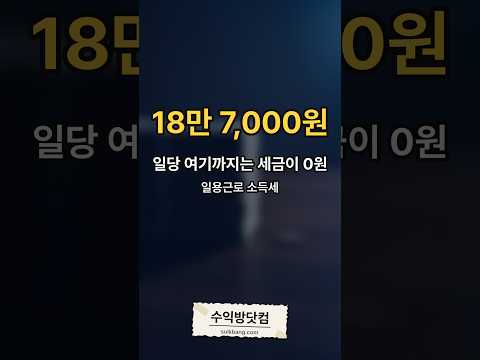 Day wages up to ₩187,000 carry no tax at allHow much tax comes off a day wage, calculated in statutory order: the ₩150,000 deduction, 6%, the 55% credit and the under-₩1,000 rule.▶ Video · Read the full piece →Read the explainer
- Selling a detached house, a 200㎡ yard costs you ₩84.62M moreHow the house-land limit for a detached house is set, why the yard beyond it loses both the exemption and long-holding table 2, and why the building price is not apportioned, all worked through on a real calculation.Read the full piece →Read the explainer